
Bug Out Bag List
A bug out bag — also called a go-bag or 72-hour kit — is a packed bag you can grab if you have to leave home quickly in a wildfire, flood, storm or other emergency. Tell the list builder who is in your household, how many days to plan for and your climate, and it creates a checklist with the water and food you need, an estimate of the weight, and boxes to tick as you pack.
- Free to use
- No sign-up
- Runs in your browser
Go-bag list builder
Emergency Go-Bag Planner
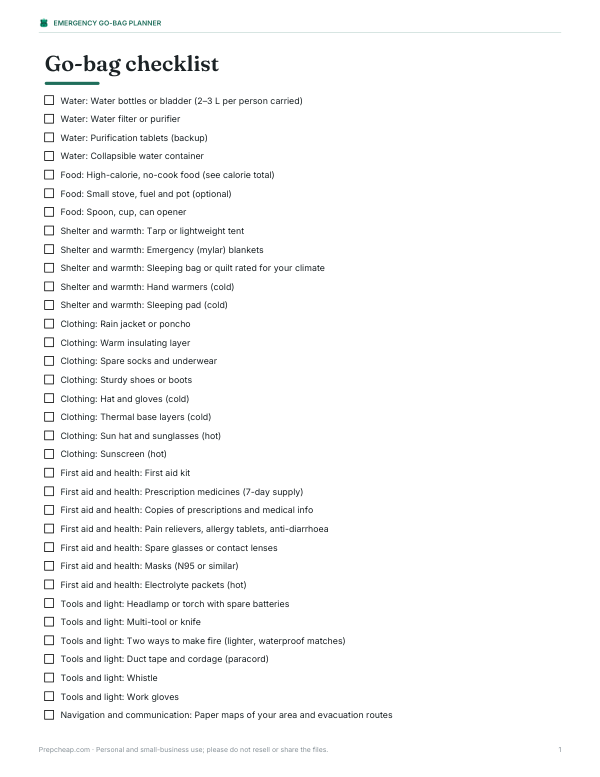
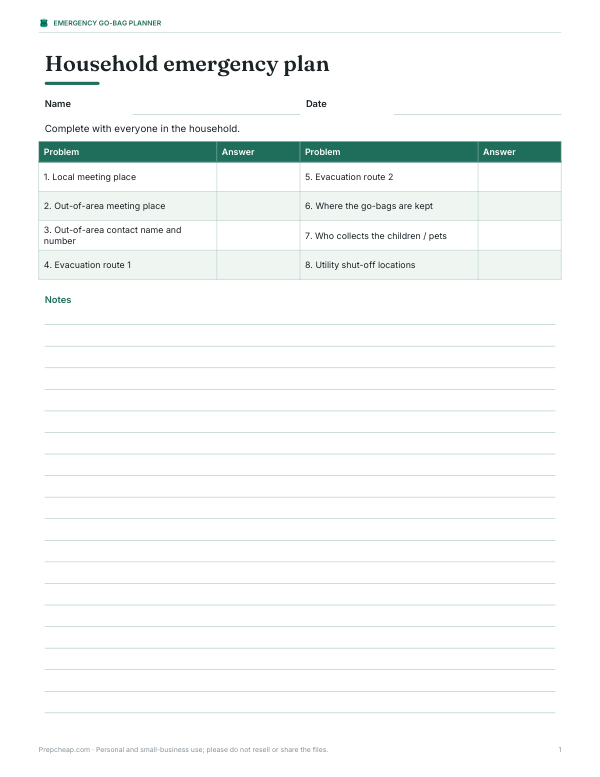
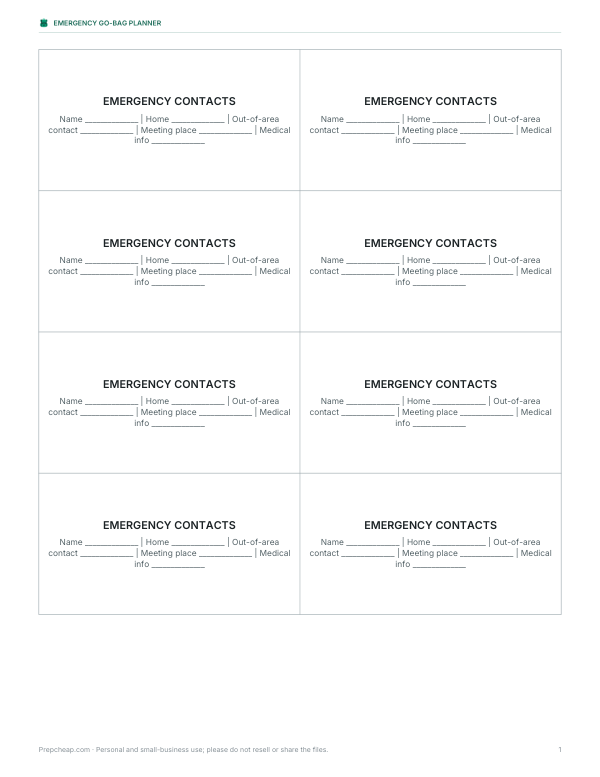
Printable emergency preparedness pack: go-bag checklist, household emergency plan template, emergency contact cards, an Excel kit inventory with expiry dates and a six-month maintenance log.
- Go-bag checklist (PDF, DOCX)
- Emergency plan (PDF, DOCX)
- Contact cards (PDF)
- Kit inventory (XLSX)
- Maintenance log (PDF, XLSX)
Formats: PDF, DOCX, XLSX. Instant download after payment (link valid 72 hours, up to 5 downloads). AI-assisted: the templates were drafted with AI help and reviewed and laid out before publishing.
$5.00 USD, one-time 5 files · about $1.00 each
- Instant download
- 7-day refund
- Secure checkout by Stripe
7-day money-back guarantee. Full refund within 7 days of purchase, even after you download.
Free sample: Emergency Contact Cards (PDF, 57 KB)
Full refund within 7 days — see the refund policy and license.
Free printables
Single sheets you can print right now, no sign-up. The full pack adds every sheet in one download plus the editable files.
 Printable Bug Out Bag Inventory Sheet
 Printable Go-Bag Maintenance Log
What is a bug out bag?
A bug out bag is a portable kit with the essentials to get through about 72 hours away from home. Emergency agencies usually call it a go-bag, grab-and-go bag or evacuation kit. The idea is simple: when there is an order to evacuate, there is no time to search the house for torches, medicines and documents. Having them packed in a bag by the door or in the car lets you leave in minutes. It is different from a home emergency kit, which is larger and meant for sheltering in place.
The core categories
| Category | Why it matters |
|---|---|
| Water | The most urgent need — you can only go about three days without it |
| Food | High-calorie, no-cook food keeps energy up during stress |
| Shelter and warmth | Exposure is a major risk in cold, wet or windy weather |
| First aid and medicines | Pharmacies may be closed; a week of prescriptions is vital |
| Light, tools and fire | Power cuts are common in disasters |
| Communication and navigation | Mobile networks may be down; paper maps and a radio still work |
| Documents and cash | Card machines and ATMs may not work; ID and insurance papers speed recovery |
How the list builder calculates
- Water: 1 US gallon (about 3.8 L) per person per day for drinking and basic hygiene, the figure used by US emergency agencies — 1.5 gallons in hot climates.
- Because water is heavy (8.34 lb per gallon), it suggests carrying 2–3 L per person and bringing a filter or tablets to treat more.
- Food: your calorie target per adult per day, with children at 70%, converted to weight at about 4 kcal per gram — typical of energy bars, nuts and dried meals.
- Items: a core list for everyone, plus extras for cold or hot climates, children and pets.
- Your ticks are saved in this browser so you can pack over several days.
Worked example
Two adults and one child with a dog, planning for three days in a mild climate: the builder suggests storing 9 gallons (34 L) of water — about 75 lb, too heavy to carry — so each person carries 2 L and the household takes a filter. Food at 2,000 kcal per adult and 1,400 for the child comes to 16,200 kcal, roughly 8.9 lb (4 kg) of dense food. A medium-sized dog needs roughly another 4.5 L of water over three days, plus food. The checklist includes a child ID card, a comfort item and the dog’s leash and vaccination records.
Keeping the weight manageable
A bag you can’t carry is no use. Many hikers aim to keep a loaded pack under about 20% of their body weight, and less for long distances. Choose light, multi-use items: a tarp instead of a heavy tent, a filter instead of lots of bottled water, and one good headlamp. Split shared items — stove, filter, first aid kit — between adults, and give children only a small bag with their own comfort items and snacks.
Maintaining your go-bag
- Check the bag every six months — for example when clocks change.
- Rotate food and water before expiry dates.
- Replace batteries and check torches and radios work.
- Update clothes as children grow and seasons change.
- Refresh medicines and copies of prescriptions.
- Review your evacuation routes and meeting point with everyone.
Plan as well as pack
A kit works best with a plan. Know your local warnings and evacuation routes, agree where your household will meet if separated, and choose an out-of-area contact everyone can call or text. Keep your vehicle’s fuel tank at least half full during high-risk seasons. Follow official instructions from your local emergency management agency — they know the specific hazards where you live.
Special needs to plan for
Think about anyone in the household with extra needs: hearing aids and batteries, mobility aids, oxygen, infant supplies or medicines that need refrigeration. Write down the details of medical devices and keep a list of medicines with doses. Older relatives and neighbours may need help to prepare their own kit and to evacuate.
Where to keep it
Store the bag somewhere cool, dry and easy to reach on the way out — a hall cupboard near the door or the boot of the car. Consider a smaller kit at work and in each vehicle. Avoid storing water in a hot car for long periods; rotate it frequently.
Frequently asked questions
What should be in a bug out bag?
Water and a filter, food, shelter and warmth, first aid and medicines, light and tools, maps and a radio, hygiene items, documents and cash.
How much water should I pack?
Store about one gallon per person per day and carry 2–3 litres each with a way to treat more.
How much food for 72 hours?
About 6,000 kcal per adult at 2,000 kcal a day — roughly 3 lb of dense food.
What is the difference between a bug out bag and an emergency kit?
A go-bag is portable for evacuation; a home kit is larger for sheltering in place.
How often should I check my go-bag?
Every six months.
Is my checklist saved?
Your ticks are saved in this browser only.
Should I keep cash in my go-bag?
Yes, small notes, because card machines and ATMs may not work during an emergency.